Sovereign AI: Local LLMs with Google Antigravity
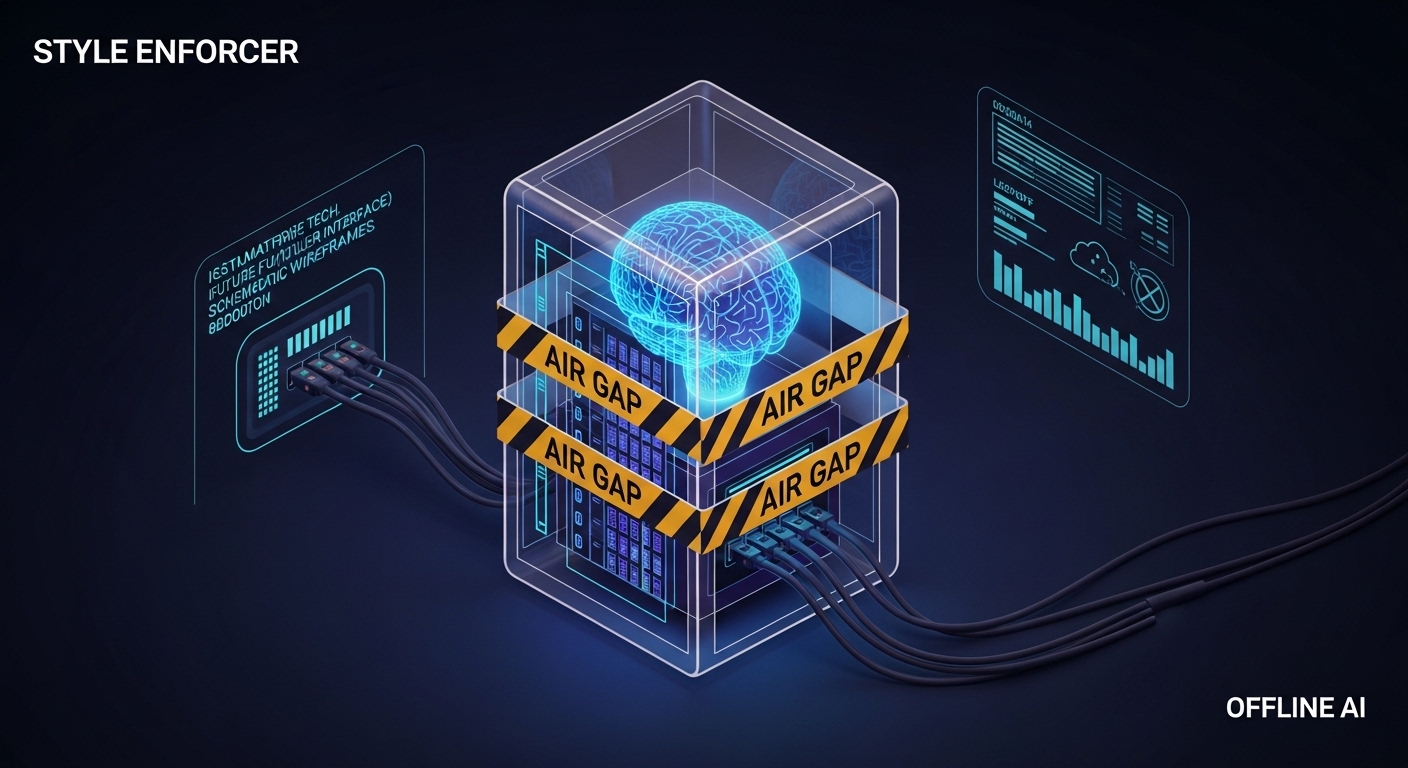
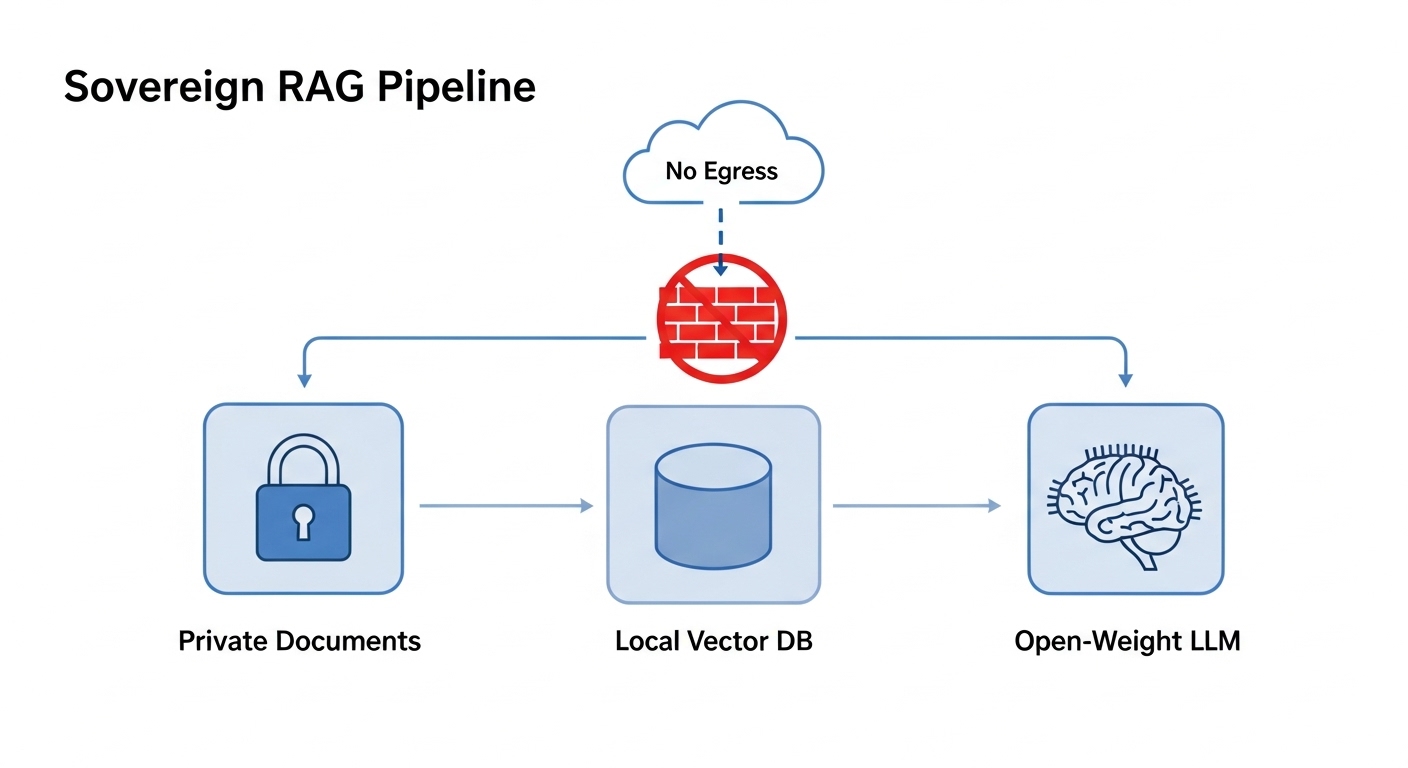
"Deploying 'Sovereign RAG' architectures to run open-weight models within air-gapped European enclaves, preventing IP leakage."
01 Sovereign AI: Implementing Local LLMs
1 Introduction: The Geopolitical and Regulatory Imperative
The rapid proliferation of Large Language Models (LLMs) into the enterprise technology stack has precipitated a fundamental collision between the promise of generative artificial intelligence and the rigid mandates of data sovereignty, privacy regulation, and intellectual property protection. As organizations rush to integrate capabilities ranging from automated code generation to semantic document analysis, they confront a critical architectural bifurcation: reliance on centralized, proprietary Model-as-a-Service (MaaS) providers versus the deployment of decentralized, sovereign infrastructure. This whitepaper argues that for entities operating within jurisdictions with stringent data protection frameworks—most notably the European Economic Area (EEA)—or for those handling sensitive proprietary data, the "Sovereign AI" approach is not merely an architectural preference but a legal and operational necessity.
The "Leakage Problem" is the central antagonist in this narrative. When an enterprise utilizes a public API for LLM inference, it effectively outsources its cognitive processing to a third party, often located in a jurisdiction with incompatible surveillance laws. The friction between the European Union’s General Data Protection Regulation (GDPR) and the United States’ CLOUD Act creates a legal paradox that standard contractual clauses and encryption-at-rest cannot fully resolve. This paper proposes a comprehensive technical solution: the repatriation of inference workloads to local infrastructure utilizing NVIDIA A100 GPUs, containerized open-weights models such as Llama 3 and Mistral, and a defensive software architecture defined as the "Sanitized Context Window."
Through a rigorous analysis of the legal landscape, hardware specifications, performance benchmarks, and security patterns, we demonstrate that the perceived trade-off between local control and model performance has largely evaporated. Modern quantized models running on enterprise-grade hardware now offer a viable, and in many metrics superior, alternative to cloud-based inference, providing the enterprise with a "Sovereign Cloud" capability that ensures data never crosses the digital, or physical, border.
2 The Leakage Problem: Anatomy of a Compliance Failure
The integration of generative AI into corporate workflows is often framed as a productivity imperative, yet the mechanisms by which these models consume and process data present profound risks. Data leakage in this context is not limited to the accidental exposure of data to the public; it encompasses the unauthorized transfer of data to third-party processors where it may be retained, logged, or utilized for model training, thereby irrevocably compromising its confidentiality and the controller's legal standing.
2.1 The Samsung Incident: A Case Study in Shadow AI
The dangers of "Shadow AI"—the unsanctioned use of public AI tools by employees—were starkly illustrated in early 2023 by the series of data leaks at Samsung Electronics. In a quest for productivity, Samsung engineers transmitted highly sensitive proprietary data to ChatGPT, a service hosted by OpenAI.
The leakage occurred through three distinct incidents, each revealing a different vector of exposure. In the first instance, an employee entered faulty source code related to the facility measurement database download program, seeking optimization and debugging assistance.1 This transmission effectively handed over trade secrets regarding Samsung’s internal semiconductor manufacturing infrastructure to a US-based entity. In a second instance, program code for identifying defective equipment was uploaded for similar optimization purposes.2 The third instance involved the transcription and summarization of a smartphone recording from a confidential company meeting, converting spoken sensitive strategic discussions into text and uploading them to the model for minute-generation.1
The consequences were immediate and severe. Because the terms of service for the standard ChatGPT offering allowed for the retention of user data to improve model performance, Samsung’s proprietary code became part of the model’s potential training corpus.3 Unlike a database entry which can be deleted, data absorbed into the weights of a neural network during training becomes part of its probabilistic distribution, theoretically retrievable by competitors through targeted prompting or "extraction attacks." Samsung was forced to implement emergency measures, capping upload capacity to 1024 bytes per prompt and eventually banning the use of generative AI on company devices entirely, retreating to the development of internal tools.2 This incident underscores that without a sovereign alternative, the pressure for productivity will inevitably drive employees to use insecure public tools, resulting in catastrophic IP loss.
2.2 The GDPR Compliance Gap: Article 28 and Beyond
For European enterprises, the use of US-based LLM APIs constitutes a transfer of personal data that must withstand the scrutiny of the GDPR. The primary mechanism for legitimizing such processing is a Data Processing Agreement (DPA) under Article 28. This article mandates that the processor (the AI provider) must act only on the documented instructions of the controller (the enterprise) and must provide sufficient guarantees to implement appropriate technical and organizational measures.4
However, the "black box" nature of public LLM APIs makes compliance with Article 28 notoriously difficult to verify. For standard or free tiers of services like ChatGPT, a robust, customizable DPA is often absent. OpenAI’s terms for these tiers historically allowed for the use of input data for model training, a processing activity that likely exceeds the "documented instructions" of a corporate controller merely seeking inference.4
The Italian Data Protection Authority (Garante) brought these issues to a head in March 2023, imposing a temporary ban on ChatGPT. The authority cited a lack of legal basis for the massive collection and processing of personal data for training algorithms, alongside failures in age verification and transparency.5 Even when enterprise editions offer DPAs that promise exclusion from training, the lack of transparency—auditing a closed-source model’s data ingestion pipeline is technically impossible for the customer—leaves the controller with significant residual risk. If a provider suffers a bug, such as the March 2023 incident where ChatGPT users could see the titles of others’ conversation histories, the controller is exposed to a data breach notification obligation without the visibility to assess the scope of the damage.2
2.3 The Transatlantic Conflict: GDPR vs. The US CLOUD Act
Perhaps the most intractable legal challenge—and the strongest argument for Sovereign AI—is the conflict between European data sovereignty and United States surveillance laws.
The GDPR Article 48 Restriction Article 48 of the GDPR explicitly states that any judgment of a court or tribunal and any decision of an administrative authority of a third country requiring a controller or processor to transfer or disclose personal data may only be recognized or enforceable if based on an international agreement, such as a Mutual Legal Assistance Treaty (MLAT).6 This article effectively forbids EU companies from complying with direct foreign subpoenas that bypass established diplomatic channels.
The US CLOUD Act Overreach In direct contradiction, the US Clarifying Lawful Overseas Use of Data (CLOUD) Act of 2018 amended the Stored Communications Act to assert extraterritorial jurisdiction. It compels US service providers (and their subsidiaries) to produce data in their possession, custody, or control, regardless of whether such data is located within or outside the United States.7 This creates a dilemma for an EU company using a US provider (e.g., Azure OpenAI, OpenAI, AWS Bedrock). Even if the data is "resident" in a data center in Frankfurt or Dublin, the US parent company is subject to CLOUD Act warrants. If served with such a warrant, the US provider is legally compelled to hand over the data, while the EU customer is legally forbidden by GDPR to allow it. The Court of Justice of the European Union (CJEU) in its Schrems II ruling invalidated the Privacy Shield framework precisely because US surveillance programs (like those authorized under FISA Section 702) do not offer judicial redress equivalent to EU law.6 While Standard Contractual Clauses (SCCs) remain a transfer mechanism, they require "supplementary measures" to ensure protection. The European Data Protection Board (EDPB) has indicated that for data available in the clear to a US provider, effectively no supplementary measure (legal or organizational) is sufficient to prevent access by US intelligence agencies. Technical measures, such as encryption where the provider does not hold the keys, are the only safeguard. Since LLM inference requires the provider to process the prompt in the clear (homomorphic encryption for LLMs remains computationally impractical), utilizing a US-controlled API is inherently incompatible with a strict interpretation of data sovereignty for sensitive data.9 The only architectural solution that resolves this conflict is ensuring the data never enters the custody of a US provider: Local LLMs.
3 The Solution: Sovereign Infrastructure Stack
To reclaim sovereignty, the enterprise must transition from a consumer of AI services to an operator of AI infrastructure. This necessitates a robust hardware and software stack capable of running high-parameter models with acceptable latency. The reference architecture proposed here utilizes NVIDIA A100 GPUs, Docker for containerization, and Ollama as the inference orchestration layer.
3.1 Hardware Architecture: The NVIDIA A100 Standard
While consumer-grade hardware (e.g., NVIDIA RTX 4090) has made local inference accessible to hobbyists, the NVIDIA A100 Tensor Core GPU remains the requisite standard for enterprise production environments. The distinction lies not merely in raw compute, but in memory architecture and reliability features essential for serving concurrent users.
3.1.1 Memory Bandwidth: The Inference Bottleneck
Large Language Model inference is predominantly a memory-bound workload. The generation of each token requires the movement of the model's entire weight set from Video RAM (VRAM) to the compute units. Consequently, the speed of generation (Tokens Per Second) correlates more linearly with memory bandwidth than with FLOPS (Floating Point Operations Per Second). The A100 utilizes High Bandwidth Memory (HBM2e), delivering a massive 1,555 GB/s of bandwidth on the 40GB model and nearly 2,039 GB/s on the 80GB model.11 In comparison, an RTX 4090 offers approximately 1,008 GB/s, and standard DDR5 system memory offers a paltry 50-100 GB/s. This bandwidth advantage allows the A100 to sustain high throughput even with the large context windows typical of RAG (Retrieval-Augmented Generation) applications.11
3.1.2 Tensor Cores and Precision
The A100 is built on the Ampere architecture, which introduced Third-Generation Tensor Cores. These cores natively support Tensor Float 32 (TF32), a format that provides the range of FP32 with the precision of FP16, accelerating training and inference without code changes. Furthermore, the A100 supports Bfloat16 (BF16), which is critical for maintaining numerical stability in large models. For inference specifically, the A100’s support for INT8 and INT4 precision is vital. Through quantization, models can be compressed to 4-bit integers, reducing memory footprint by 75% while leveraging the A100’s specialized integer math pipelines to further boost throughput.12
3.1.3 Scalability: NVLink and MIG
For models that exceed the VRAM of a single card (e.g., Llama 3 70B in FP16 requires ~140GB), the A100 supports NVLink, a high-speed interconnect that bridges multiple GPUs. This allows two A100s to function as a single unified memory space of 160GB, enabling "Model Parallelism" (splitting layers across GPUs) or "Tensor Parallelism" (splitting matrices across GPUs) with minimal latency penalties.11 Additionally, Multi-Instance GPU (MIG) technology allows a single A100 to be partitioned into up to seven isolated GPU instances. While typically used for training, in an inference context, this allows a single card to serve seven distinct, smaller models (e.g., seven Mistral 7B instances) simultaneously, guaranteeing Quality of Service (QoS) for different departments.14
3.2 Software Architecture: Docker and Ollama
The software layer must abstract the complexity of GPU management while providing a stable, reproducible API surface. We select Docker as the runtime environment and Ollama as the model server.
3.2.1 The Ollama Advantage
Ollama has emerged as the de facto standard for local LLM orchestration due to its seamless integration of the llama.cpp backend.
Backend Abstraction: Ollama wraps llama.cpp, which is highly optimized for Apple Silicon and NVIDIA GPUs. It automatically handles the loading of GGUF (GPT-Generated Unified Format) models, a binary format designed for fast loading and mapping to memory.15
Automatic Offloading: One of Ollama's critical features is its ability to intelligently offload model layers. If the model size exceeds VRAM, Ollama can split the model, running some layers on the GPU and the remainder on the CPU/RAM. While this degrades performance, it prevents Out-of-Memory (OOM) crashes, providing resilience.16
Concurrency Management: Ollama supports the OLLAMA_NUM_PARALLEL environment variable. By default, many local runners process requests serially. Configuring this variable allows the A100 to process multiple request streams simultaneously, utilizing its massive compute parallelism to serve a department of users.17
3.2.2 Containerized Deployment Configuration
Deploying the stack via Docker ensures that the inference environment is hermetic—it shares no dependencies with the host OS other than the NVIDIA driver. This isolation is a core tenet of the "Sovereign" security posture.
The deployment requires the NVIDIA Container Toolkit, which allows the Docker container to access the GPU hardware via the --gpus flag.12 Below is a reference docker-compose.yml configuration optimized for an A100 environment:
YAML
version: '3.8'
services:
  ollama:
    image: ollama/ollama:latest
    container_name: sovereign-ollama
    restart: always
    ports:
      - "11434:11434"
    environment:
      - OLLAMA_HOST=0.0.0.0
      - OLLAMA_NUM_PARALLEL=4      # Enables concurrent processing for 4 users
      - OLLAMA_MAX_LOADED_MODELS=1 # Prevents memory fragmentation
      - OLLAMA_KEEP_ALIVE=24h      # Keeps model in VRAM to avoid cold-start latency
      - NVIDIA_VISIBLE_DEVICES=all
    deploy:
      resources:
        reservations:
          devices:
            - driver: nvidia
              count: 1
              capabilities: [gpu]
    volumes:
      -./ollama-data:/root/.ollama
In this configuration, OLLAMA_NUM_PARALLEL is set to 4. On an A100 80GB, a quantized Llama 3 70B model consumes approximately 43GB of VRAM.20 This leaves nearly 37GB of VRAM for the KV cache (Context Window) of the parallel requests. If this variable is not set, the GPU will process requests one by one, leading to unacceptable queuing latency in a multi-user environment.17
3.3 Model Selection: The Sovereignty Spectrum
The choice of model dictates the capabilities of the sovereign stack. Two primary contenders dominate the open-weights landscape: Llama 3 (Meta) and Mistral (Mistral AI).
Llama 3 (70B Instruct) Released by Meta, Llama 3 represents the current state-of-the-art for open weights. The 70B parameter variant demonstrates reasoning capabilities that rival GPT-4 class models on benchmarks like MMLU and HumanEval.21
Sovereignty Note: While "Open Weights," Llama 3 is licensed under a custom Community License, not a traditional open-source license (like Apache 2.0). However, for enterprise internal use, it is effectively unrestricted.
Hardware Fit: The 70B model is the ideal candidate for the A100. Running in Q4_K_M (4-bit quantization), it requires ~42.5 GB of VRAM. This fits entirely on a single A100 80GB with room to spare, or can be split across two A100 40GB cards.20
Mistral / Mixtral
Mistral AI, a French company, offers a strategic advantage for EU entities seeking alignment with European technological sovereignty.
Mistral 7B: A highly efficient smaller model, ideal for high-throughput summarization tasks where deep reasoning is secondary to speed. It can run on much smaller hardware partition.23
Mixtral 8x7B / 8x22B: These are Mixture-of-Experts (MoE) models. They offer a compelling balance, activating only a subset of parameters per token. This provides high intelligence with faster inference speeds than dense models of equivalent size.24
For the reference architecture, we standardize on Llama 3 70B (Quantized) for general-purpose reasoning due to its superior instruction-following capabilities, while retaining Mistral 7B for low-latency specialized tasks.25
4 Performance: Benchmarking the Sovereign Cloud
A pervasive myth hindering the adoption of local LLMs is the belief that local hardware cannot compete with the performance of hyperscale cloud APIs. "It will be too slow" is the standard objection. This section presents a rigorous performance analysis, demonstrating that a properly configured A100 sovereign stack not only competes with but often outperforms public APIs in key latency metrics.
4.1 Comparison Metrics
To accurately evaluate performance, we distinguish between three metrics:
Time to First Token (TTFT): The latency between the request being sent and the first character appearing. This measures the responsiveness of the system and is dominated by the "prefill" phase (processing the input prompts).
Throughput (Tokens Per Second - TPS): The rate at which the model generates text after the first token. This determines how quickly the full response is completed.
Inter-Token Latency (ITL): The consistency of the generation. High variance in ITL leads to a "stuttering" experience for the user.
4.2 Benchmark Results: A100 vs. Public API
Table 1 presents consolidated benchmark data comparing a local Llama 3 70B instance on an A100 80GB against the OpenAI GPT-4o API.
Table 1: Sovereign A100 vs. Public Cloud API Performance
| Metric | Local Llama 3 70B (A100 80GB, Q4_K_M) | OpenAI GPT-4o API | Mistral Large API |
| Time to First Token (TTFT) | ~300 - 500 ms | 540 - 800 ms | ~410 ms |
| Throughput (TPS) | 18 - 25 t/s | 80 - 160 t/s | ~35 t/s |
| Latency Stability | High (Deterministic) | Low (Variable Network/Queue) | Medium |
| Privacy Guarantee | Absolute (Air-gapped) | Contractual (DPA) | Contractual (DPA) |
| Cost Model | Fixed (CapEx/Lease) | Variable ($/Token) | Variable ($/Token) |
Sources: 26
Analysis of Results
The Latency Advantage: The local A100 achieves a TTFT of 300-500ms, which is consistently lower than the GPT-4o API.30 Public APIs suffer from network round-trip time (RTT), load balancer queuing, and "cold starts" where the model must be loaded into memory on the provider's side. The local A100, with the model permanently resident in VRAM (OLLAMA_KEEP_ALIVE), eliminates these overheads.
The Throughput Trade-off: While GPT-4o can burst to 160 t/s (especially on Azure), the local A100’s 18-25 t/s for a 70B model is entirely sufficient for human interaction.26 The average human reading speed is roughly 5-8 tokens per second. Therefore, generation speeds above 20 t/s are perceived as "instant" by the user. The massive throughput of cloud APIs is often wasted on the user interface, only beneficial for batch processing.
Quantization Impact: Utilizing 4-bit quantization (Q4_K_M) is the key enabler of this performance. It reduces the Llama 3 70B model size from ~140GB (FP16) to 42.5GB. This reduction allows the entire model to sit in the high-speed HBM2e memory of a single GPU, avoiding the latency penalty of communicating across PCIe or NVLink to a second card.20 Benchmarks show that Q4 quantization results in negligible degradation of perplexity (intelligence) while doubling inference speed compared to FP16.20
4.3 Engine Selection: vLLM vs. Ollama
For enterprise architects, a critical decision point is the choice of inference engine. While Ollama is favored for its developer experience and simplicity, vLLM (Virtual Large Language Model) represents the high-performance alternative focused on maximum throughput.
Table 2: Engine Capability Comparison (Llama 3 70B on A100)
| Feature | Ollama | vLLM |
| Primary Focus | Usability / DevEx | Raw Throughput / Scaling |
| Memory Management | Standard Loading | PagedAttention |
| Peak Throughput (Agg) | ~40 TPS (Concurrency Limiting) | ~793 TPS (Batching) |
| Complexity | Low (Single Binary/Container) | High (Python/Config Tuning) |
| Multi-GPU Scaling | Limited (Basic Split) | Advanced (Tensor Parallelism) |
Sources: 33
The PagedAttention Difference vLLM utilizes PagedAttention, an algorithm inspired by operating system virtual memory paging. It partitions the Key-Value (KV) cache into blocks that can be stored in non-contiguous memory spaces. This dramatically reduces memory fragmentation, allowing the engine to batch significantly more concurrent requests.33
Benchmark Insight: Under high load (e.g., 250 concurrent users), vLLM can sustain aggregate throughputs of nearly 800 TPS, whereas Ollama may throttle or degrade to 40 TPS as it struggles to manage the memory for so many context windows simultaneously.33
Recommendation: For single-department deployments, prototypes, or agentic workflows where ease of management is paramount, Ollama is the superior choice. Its performance on an A100 is more than adequate for moderate concurrency. However, if the Sovereign AI service is intended to serve an entire enterprise (1000+ users), the architecture should transition to vLLM to leverage PagedAttention and efficient continuous batching.33
5 Architectural Defense: The 'Sanitized Context Window'
Deploying a local LLM resolves the issue of external data leakage (GDPR/CLOUD Act), but it does not inherently solve internal security challenges. An employee might still inadvertently paste PII (e.g., customer credit card numbers, colleague salaries, or private encryption keys) into the local chatbot. While this data stays within the company's network, it may be logged in prompt history databases, visible to IT administrators, or injected into the context of other users if the system is not perfectly isolated. Furthermore, creating a "clean" dataset for future fine-tuning requires that this data be free of PII.
To address this, we introduce the Sanitized Context Window architecture. This pattern employs a "defense-in-depth" strategy by placing a PII detection and masking layer upstream of the inference engine. The LLM never sees the sensitive data; it only sees sanitized placeholders.
5.1 Architecture Components
The Sanitized Context Window stack consists of three distinct layers orchestrated via Docker:
The Gateway (LiteLLM): Acts as the API proxy and policy enforcement point.
The Sanitizer (Microsoft Presidio): Provides NLP-based PII detection and reversible masking.
The Engine (Ollama): Performs the inference on the sanitized text.
5.1.1 Microsoft Presidio: The Sanitization Engine
Microsoft Presidio is the industry-standard open-source framework for PII detection. It is architected into two services: the Analyzer and the Anonymizer.36
Detection Mechanism (Analyzer)
Presidio Analyzer utilizes a hybrid approach to detection:
Named Entity Recognition (NER): It employs spaCy-based models (e.g., en_core_web_lg) to detect context-dependent entities like "Person," "Location," or "Organization."
Pattern Matching (Regex): It uses robust regular expressions for structured data like Credit Card Numbers, IBANs, US Social Security Numbers, and Email Addresses.
Checksum Validation: For entities with checksums (like credit cards or national IDs), it validates the logic to reduce false positives.38
Reversible Pseudonymization (Anonymizer)
Crucially, for an LLM to function correctly, the data cannot simply be redacted (blacked out). The semantic structure of the sentence must be preserved. Presidio allows for Reversible Pseudonymization.
Input: "Contact John Smith at 555-0199."
Sanitized: "Contact <PERSON_1> at <PHONE_NUMBER_1>." The mapping {<PERSON_1>: "John Smith", <PHONE_NUMBER_1>: "555-0199"} is stored temporarily in the Gateway's memory. The LLM receives the sanitized string, generates a response (e.g., "I will draft a message to <PERSON_1>..."), and the Gateway then de-anonymizes the output before showing it to the user. This ensures the LLM weights and context window are never polluted with the PII.39
5.1.2 LiteLLM Gateway Integration
LiteLLM acts as the unified interface for the stack. It creates an OpenAI-compatible server that sits between the client applications and Ollama. It is configured with "Guardrails" that invoke Presidio.
Implementation Workflow:
Interception: The user sends a prompt to the LiteLLM port (e.g., 4000).
Scan: LiteLLM sends the prompt text to the Presidio Analyzer container (Port 5002).
Decision: If PII is detected above a confidence threshold (e.g., 0.7), the text is sent to the Presidio Anonymizer container (Port 5001).
Inference: The sanitized text is forwarded to Ollama (Port 11434).
Reconstruction: The response is received, optionally de-anonymized, and returned to the user.
5.2 Deployment: The Integrated Stack
The entire architecture can be defined in a single docker-compose.yml file, creating a self-contained, secure AI appliance.
YAML
version: '3.8'

services:
  # 1. The Sovereign Inference Engine
  ollama:
    image: ollama/ollama:latest
    container_name: sovereign-ollama
    restart: always
    environment:
      - OLLAMA_HOST=0.0.0.0
      - NVIDIA_VISIBLE_DEVICES=all
    deploy:
      resources:
        reservations:
          devices:
            - driver: nvidia
              count: 1
              capabilities: [gpu]
    volumes:
      -./ollama-data:/root/.ollama
    ports:
      - "11434:11434"

  # 2. PII Detection Service
  presidio-analyzer:
    image: mcr.microsoft.com/presidio-analyzer:latest
    environment:
      - NLP_ENGINE_NAME=spacy
      - RECOGNIZER_REGISTRY_CONFIGURATION=file
    ports:
      - "5002:5002"

  # 3. PII Masking Service
  presidio-anonymizer:
    image: mcr.microsoft.com/presidio-anonymizer:latest
    ports:
      - "5001:5001"

  # 4. The Guardrail Gateway
  litellm:
    image: ghcr.io/berriai/litellm:main-latest
    ports:
      - "4000:4000"
    volumes:
      -./litellm_config.yaml:/app/config.yaml
    command: [ "--config", "/app/config.yaml", "--detailed_debug"]
    environment:
      - PRESIDIO_ANALYZER_API_BASE=http://presidio-analyzer:5002
      - PRESIDIO_ANONYMIZER_API_BASE=http://presidio-anonymizer:5001
    depends_on:
      - ollama
      - presidio-analyzer
      - presidio-anonymizer
Sources: 19
5.3 Performance Overhead and Limitations
Security always incurs a latency cost. Benchmarks indicate that the Presidio Analyzer adds approximately 10-50ms for short texts, but this can scale to 100-200ms for larger context blocks depending on the complexity of the NLP model used.42 Furthermore, Presidio is not infallible. As a probabilistic system, it has a non-zero error rate. It may miss unconventional PII or false-positive on innocuous text. Therefore, this system should be viewed as a Risk Reduction mechanism—stripping 99% of PII—rather than a guarantee of zero leakage. For "Sovereign" environments, this is acceptable because the backend (Ollama) is already trusted and local; the Sanitized Context Window is an additional internal control, not the sole line of defense.39
6 Conclusion: The Future of Sovereign AI
The era of unrestricted, unregulated data transmission to public AI endpoints is drawing to a close. The convergence of strict regulatory enforcement—epitomized by the Italian DPA’s actions and the looming EU AI Act—and the operational reality of industrial espionage and trade secret leakage has made the "black box" API model untenable for sensitive enterprise data.
This whitepaper has demonstrated that the solution—Sovereign AI—is no longer a theoretical aspiration constrained by hardware limitations. The NVIDIA A100 provides the memory bandwidth necessary to run 70-billion parameter models like Llama 3 at speeds that rival or exceed human reading capabilities. The software ecosystem, anchored by Docker and Ollama, has matured to the point where deploying a private, OpenAI-compatible API is a matter of configuration, not invention. And with architectural patterns like the Sanitized Context Window, organizations can enforce data governance policies programmatically, ensuring that PII is masked before it ever touches the inference layer.
By repatriating the inference workload, the enterprise achieves three critical victories:
Legal Compliance: Absolute adherence to GDPR data residency requirements, neutralizing the threat of the US CLOUD Act.
Intellectual Property Security: A guarantee that proprietary code and strategy never become training data for a competitor's model.
Operational Resilience: Immunity from the outages, rate limits, and policy changes of public cloud providers.
The path forward is clear. The enterprise of the future will not merely be a user of AI, but a custodian of it. Sovereign AI is the foundation of that custody.
027 Citations
1
Works cited
A Case Study on Samsung's ChatGPT Incident - HumanFirewall, accessed January 27, 2026, https://humanfirewall.io/case-study-on-samsungs-chatgpt-incident/
Samsung employees leaked corporate data in ChatGPT: report - CIO Dive, accessed January 27, 2026, https://www.ciodive.com/news/Samsung-Electronics-ChatGPT-leak-data-privacy/647137/
Whoops, Samsung workers accidentally leaked trade secrets via ChatGPT - Mashable, accessed January 27, 2026, https://mashable.com/article/samsung-chatgpt-leak-details
How to use ChatGPT in your company in compliance with the GDPR - activeMind.legal, accessed January 27, 2026, https://www.activemind.legal/guides/chatgpt/
Data Protection aspects when using the ChatGPT-API | Simpliant Insights, accessed January 27, 2026, https://simpliant.eu/insights/GDPR-requirements-when-using-chatgpt-api
CLOUD Act vs. GDPR: The Conflict About Data Access Explained – - Exoscale, accessed January 27, 2026, https://www.exoscale.com/blog/cloudact-vs-gdpr/
Clarifying Lawful Overseas Use of Data (CLOUD) Act - Amazon Web Services, accessed January 27, 2026, https://aws.amazon.com/compliance/cloud-act/
CLOUD Act - Wikipedia, accessed January 27, 2026, https://en.wikipedia.org/wiki/CLOUD_Act
What's the Difference Between Private LLMs and Public LLMs? - Clairo AI, accessed January 27, 2026, https://www.clairo.ai/blog/privatellms-vs-publicllms
Industry News 2024 Cloud Data Sovereignty Governance and Risk Implications of Cross Border Cloud Storage - ISACA, accessed January 27, 2026, https://www.isaca.org/resources/news-and-trends/industry-news/2024/cloud-data-sovereignty-governance-and-risk-implications-of-cross-border-cloud-storage
Run LLMs with Ollama on A100 GPUs for Maximum Efficiency - centron GmbH, accessed January 27, 2026, https://www.centron.de/en/tutorial/run-llms-with-ollama-on-a100-gpus-for-maximum-efficiency/
LLaMA 3.3 Installation with Docker – Step-by-Step Guide - Cloudfront.net, accessed January 27, 2026, https://d1rdz15x9x7c4f.cloudfront.net/assets/images/llama3.3-installation-guide.pdf
Self-Hosting LLaMA 3.1 70B (or any ~70B LLM) Affordably | by Abhinand | Medium, accessed January 27, 2026, https://abhinand05.medium.com/self-hosting-llama-3-1-70b-or-any-70b-llm-affordably-2bd323d72f8d
Run LLMs with Ollama on H100 GPUs for Maximum Efficiency | DigitalOcean, accessed January 27, 2026, https://www.digitalocean.com/community/tutorials/run-llms-with-ollama-on-h100-gpus-for-maximum-efficiency
bartowski/Meta-Llama-3-70B-Instruct-GGUF - Hugging Face, accessed January 27, 2026, https://huggingface.co/bartowski/Meta-Llama-3-70B-Instruct-GGUF
Ollama Performance Tuning: GPU Optimization Techniques for Production - Collabnix, accessed January 27, 2026, https://collabnix.com/ollama-performance-tuning-gpu-optimization-techniques-for-production/
Ollama seems to be limited by single CPU thread on multi GPU machine with parallel processing enable #5756 - GitHub, accessed January 27, 2026, https://github.com/ollama/ollama/issues/5756
FAQ - Ollama's documentation, accessed January 27, 2026, https://docs.ollama.com/faq
Local AI Setup with Ollama and Nvidia GPU on Ubuntu Linux - Rietta.com, accessed January 27, 2026, https://rietta.com/blog/ollama-with-nvidia-gpu-in-docker-compose/
Meta Llama 3.1 70B Instruct GGUF · Models - Dataloop, accessed January 27, 2026, https://dataloop.ai/library/model/second-state_meta-llama-31-70b-instruct-gguf/
llama3.1:70b - Ollama, accessed January 27, 2026, https://ollama.com/library/llama3.1:70b
bartowski/Hermes-3-Llama-3.1-70B-GGUF - Hugging Face, accessed January 27, 2026, https://huggingface.co/bartowski/Hermes-3-Llama-3.1-70B-GGUF
Mistral 7B Instruct vs GPT-4 - Detailed Performance & Feature Comparison - DocsBot AI, accessed January 27, 2026, https://docsbot.ai/models/compare/mistral-7b-instruct/gpt-4
Benchmarking fast Mistral 7B inference - Baseten, accessed January 27, 2026, https://www.baseten.co/blog/benchmarking-fast-mistral-7b-inference/
Absolute beginner here. Llama 3 70b incredibly slow on a good PC. Am I doing something wrong? : r/LocalLLaMA - Reddit, accessed January 27, 2026, https://www.reddit.com/r/LocalLLaMA/comments/1c8nufp/absolute_beginner_here_llama_3_70b_incredibly/
Benchmarking LLMs on Ollama with Dual Nvidia A100 GPUs - YouTube, accessed January 27, 2026, https://www.youtube.com/watch?v=MPU7L1DFhIw
Post your tokens per second for llama3.1:70b : r/LocalLLaMA - Reddit, accessed January 27, 2026, https://www.reddit.com/r/LocalLLaMA/comments/1egxdpt/post_your_tokens_per_second_for_llama3170b/
GPT-4o (Nov '24) Intelligence, Performance & Price Analysis, accessed January 27, 2026, https://artificialanalysis.ai/models/gpt-4o
GPT-4o-2024–08–06 slower then previous version - API - OpenAI Developer Community, accessed January 27, 2026, https://community.openai.com/t/gpt-4o-2024-08-06-slower-then-previous-version/979612
GPT-4o (Aug '24) API Provider Benchmarking & Analysis, accessed January 27, 2026, https://artificialanalysis.ai/models/gpt-4o-2024-08-06/providers
Mistral Large (Feb): API Provider Benchmarking & Analysis, accessed January 27, 2026, https://artificialanalysis.ai/models/mistral-large/providers
Evaluating Llama 3.3 70B Inference on NVIDIA H100 and A100 GPUs, accessed January 27, 2026, https://blog.silexdata.com/blog/evaluating-llama-33-70b-inference-h100-a100/
Ollama vs. vLLM: A deep dive into performance benchmarking | Red Hat Developer, accessed January 27, 2026, https://developers.redhat.com/articles/2025/08/08/ollama-vs-vllm-deep-dive-performance-benchmarking
vLLM vs Ollama: Key differences, performance, and how to run them | Blog - Northflank, accessed January 27, 2026, https://northflank.com/blog/vllm-vs-ollama-and-how-to-run-them
Performance vs Practicality: A Comparison of vLLM and Ollama | by Robert McDermott, accessed January 27, 2026, https://robert-mcdermott.medium.com/performance-vs-practicality-a-comparison-of-vllm-and-ollama-104acad250fd
Presidio PII Masking with LiteLLM - Complete Tutorial, accessed January 27, 2026, https://docs.litellm.ai/docs/tutorials/presidio_pii_masking
Presidio: Data Protection and De-identification SDK - Microsoft Open Source, accessed January 27, 2026, https://microsoft.github.io/presidio/
Presidio by Microsoft: A Practical Guide to Detecting and Masking PII at Scale - Medium, accessed January 27, 2026, https://medium.com/@nkbvikram/presidio-by-microsoft-a-practical-guide-to-detecting-and-masking-pii-at-scale-c3b39ce4f52c
Microsoft Presidio: an engineer's introduction to PII detection and de-identification - Medium, accessed January 27, 2026, https://medium.com/neural-engineer/microsoft-presidio-an-engineers-introduction-to-pii-detection-and-de-identification-6a7c3fed6e50
Why Presidio and Other Data Masking Tools Fall Short for AI Use Cases - Protecto AI, accessed January 27, 2026, https://www.protecto.ai/blog/why-presidio-other-data-masking-tools-fall-short-ai-use-cases-part-1/
PII Masking LLM calls using LiteLLM proxy - Microsoft Presidio, accessed January 27, 2026, https://microsoft.github.io/presidio/samples/docker/litellm/
Sensitive data flows fast. Microsoft Presidio Real-Time PII Masking stops it from leaking., accessed January 27, 2026, https://hoop.dev/blog/sensitive-data-flows-fast-microsoft-presidio-real-time-pii-masking-stops-it-from-leaking/
microsoft/presidio: An open-source framework for detecting, redacting, masking, and anonymizing sensitive data (PII) across text, images, and structured data. Supports NLP, pattern matching, and customizable pipelines. - GitHub, accessed January 27, 2026, https://github.com/microsoft/presidio
I accidentally put PII into ChatGPT : r/womenintech - Reddit, accessed January 27, 2026, https://www.reddit.com/r/womenintech/comments/1krf8dd/i_accidentally_put_pii_into_chatgpt/
Privacy policy - OpenAI, accessed January 27, 2026, https://openai.com/policies/row-privacy-policy/
Benchmarking Mistral-7B: Latency, Cost, RPS Analysis - TrueFoundry, accessed January 27, 2026, https://www.truefoundry.com/blog/benchmarking-mistral-7b
Design Patterns for Securing LLM Agents against Prompt Injections - arXiv, accessed January 27, 2026, https://arxiv.org/html/2506.08837v1
Au Large | Mistral AI, accessed January 27, 2026, https://mistral.ai/news/mistral-large
mythrantic/ollama-docker: Welcome to the Ollama Docker Compose Setup! This project simplifies the deployment of Ollama using Docker Compose, making it easy to run Ollama with all its dependencies in a containerized environment - GitHub, accessed January 27, 2026, https://github.com/mythrantic/ollama-docker
Adraca AI Research
Published Jan 22, 2026